
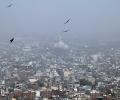
The poisonous haze has been causing significant problems for people with existing respiratory issues, according to doctors.

This time, Delhi saw a sharp improvement in air quality just ahead of Diwali which can be attributed to intermittent rainfall on Friday and wind speed favourable for the dispersion of pollutants.
IMD Director General Mrutyunjay Mohapatra said that inducing artificial rain can only be attempted when there are clouds or moisture available.

The city's Air Quality Index (AQI) stood at 420 at 8 am on Thursday, compared to 426 at 4 pm on Wednesday. The AQI map prepared by the Central Pollution Control Board showed clusters of red dots (indicating hazardous air quality) spread across the Indo-Gangetic plains.

The India Meteorological Department (IMD) predicted that cold wave to severe cold wave conditions are very likely to continue in northwest India over the next three days and abate thereafter.

East and northeast India recorded 29 per cent rain deficit -- 141.5 mm against the normal of 199.9 mm -- from March 1 to May 3.

The air quality is expected to improve further due to wind speed favourable for the dispersion of pollutants.

The two neighbouring states have been reeling under a cold wave with night temperatures ranging upto 2 degrees Celsius below normal at some places.

The mercury breached the 46-degree Celsius mark in several places such as Allahabad (46.8 degrees Celsius) and Jhansi (46.2 degrees Celsius) in Uttar Pradesh; Sports Complex (46.4 degrees Celsius) in Delhi; Ganganagar (46.4 degrees Celsius) in Rajasthan; Nowgong (46.2 degrees Celsius) in Madhya Pradesh; and Maharashtra's Chandrapur (46.4 degrees Celsius).

The maximum temperature at the Safdarjung Observatory, Delhi's base station, is likely to rise to 45 degrees Celsius.

The mercury in Delhi, which recorded its hottest day of the year so far at 45.6 degrees Celsius on Sunday, came down to 42.4 degrees Celsius, according to the India meteorological department.

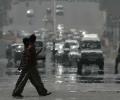
Around 29 trains have been delayed by two to five hours due to foggy weather, a railway official said.

The India Meteorological Department has issued an 'orange' alert.

The average temperatures observed pan-India for April was 35.05 degrees, which was the fourth highest in 122 years.

The desi model owns a spotlight-stealing wardrobe.

Punjab National Bank claims Vadodara municipal corporation worker Shantilal Solanki owes them Rs 16 crores.
Several global models are predicting El Nio to appear around the second half of the year, which are the crucial rain-bearing months.

'After the 4th of May we can expect thunderstorms, dust storms and some rain over a large area of north India.'

In Delhi, Safdarjung, the base station for the national capital, recorded 44.2 degrees Celsius, while Mungeshpur observatory in northwest Delhi, reported 47.3 degrees Celsius.

Despite the national capital recording its best air quality on Diwali day in eight years, pollution levels may rise due to low night temperatures and sporadic burning of firecrackers though there is a ban on their manufacture, storage, sale and use within the city.

India is likely to experience below-normal monsoon rainfall this year, with a 20 per cent chance of drought due to the end of La Nina conditions and the potential for El Nino to take hold, private forecasting agency Skymet Weather said on Monday.

India is experiencing its worst heat wave in 122 years.

The IMD defines a normal monsoon as one which delivers between 96 and 104 per cent of the 50-year average rainfall for the season.

According to an IMD forecast issued on Thursday, a heatwave spell will persist over northwest and central India during the next five days and over east India during the next three days.

Pathankot, Bathinda, Amritsar, Ambala and Sonipat, continued to witness foggy conditions in the morning.

Prime Minister Modi last week called for optimal grain storage, fire audits and mock drills in hospitals as preparations for the harsh summer forecast by the meteorological department.
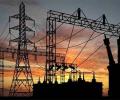
With the cooling down of heatwaves as the monsoon spreads across the country, power demand has fallen by 12.5 per cent from the start of this month till Monday. Peak power demand of the country had touched a record of 210 Gw last week, mostly due to rising temperatures and opening up of the economy. Compared with the beginning of this month, almost all states have seen a fall in power demand. Punjab, however, is an exception where the power demand on Monday was 17 per cent higher than on June 1.

"We are expecting that the temperature will be higher than normal in the entire northwest India and the adjoining central India, starting with Gujarat, Rajasthan and up to east Madhya Pradesh and Chhattisgarh," he said at a virtual event on 'Building Climate Resilience for the Most Heat Vulnerable'.
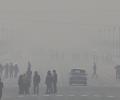
The minimum temperatures are very likely to fall by 2-5 degrees Celsius over most parts of East India, Central India over the next two-three days, while the spell of intense cold can extend beyond that in the Northwest part of the country.
It was the coldest city in the plains with the mercury touching 0.3 degree Celsius, four below normal.


Very light rains and thundershowers occurred at isolated places in Uttar Pradesh though, and a fresh warning of heavy showers was issued in Himachal Pradesh as the India Meteorological Department (IMD) said heavy to very heavy rainfall is likely in several parts of the country, including the northern region, over the next six-seven days.

A railway official said around 20 trains were delayed by 15 minutes to 2 hours in the morning.

Let's look at some the pictures of KL Rahul and his team-mates's beach pictures are a perfect tease to beat the Arabian heat.

The IMD, in its review for the month, said the observed monthly average maximum, minimum and mean temperature for the country as a whole during March this year are 32.65 degrees Celsius, 19.95 degrees Celsius and 26.30 degrees Celsius, respectively, against the normal 31.24 degrees Celsius, 18.87 degrees Celsius and 25.06 degrees Celsius based on the climatology period 1981-2010.

The January of 1919 recorded 15 degree Celsius and it remains the warmest January so far. "So January 2021 has also become the warmest in 62 years after 1958," the IMD said.

Shilpa shoots in Punjab... Kalki misses Goa... Sonal in Dubai...

Santosh Patkar of Devgadh Taluka Sindhudurg district of Maharashtra is a worried man these days. Devgadh, which is known as the home to world famous Alphonso variety of mangoes, has seen an unusual drop in yields which is affecting farmers' income. Being one of the primary agricultural produce from the area, Santosh is not untouched by this somewhat rare phenomenon. He said in his own mango garden, yields have come down by a third from most trees.

Delhi is likely to receive the first monsoon showers on June 30 or July 1, India Meteorological Department (IMD) officials said on Tuesday.

Supreme Court's ruling favouring Haryana on the contentious Sutlej-Yamuna Link canal issue has set political temperature soaring in Punjab, with the state Congress chief Amarinder Singh quitting as Member of Parliament and all MLAs following suit, as Chief Minister Parkash Singh Badal asserted "not a drop of water" will be allowed to be taken out of the state.
